
Deciding on a career involves a hundred small decisions. Is the work fulfilling? Where can I do it? How much does it pay? What are the hours? On and on. But finding your calling is like any relationship: it just has to come naturally.
For Carefor Support Centre Supervisor, Michele Morgan, her career started as a part-time Administrative Assistant at the North Stor Seniors Support Centre in Finch when the building first opened in 1993.
She stayed there for over a decade, bringing her young children in to help with the activities for the seniors who visited the centre. However, in 2004, her curiosity about other career opportunities became too strong to ignore, so she got her insurance broker’s license and started working at an insurance agency, “because like everyone else you think there’s something better happening,” Michele recalls.
“You find out who you want to be and you be that person regardless.”
To say going from the social community of the North Stor Seniors Support Centre to an insurance agency was a change, is an understatement. “It was a lot of paper and a lot of busy time but not a lot of one on one with the client,” Michele says. “There was no feel good about it.”
She started to consider if she made the right move and when she was told that the person who replaced her at North Stor was leaving, she returned to Carefor. It was then that she understood how one’s life can’t be lived in compartments. To be one person in one place and another somewhere else is no way to live a life. “You find who you want to be, and you be that person regardless,” she says. “I thought that’s where I belong, and I’ll kick myself if I don’t apply.”
She also saw how working at North Stor wasn’t just part of her, it was a family. “My kids were born when I was there,” she recalls with a smile. “The most impactful time of my life was at the centre. That was my family. When I stepped outside of that, I saw wanting to be “more” wasn’t what made me feel good.”
Not long after returning to Carefor she moved from Administrative Assistant to Program Coordinator and then to her current position as Supervisor for both North Stor Support Centre in Finch and South Stormont Support Centre in Ingleside.
Looking over her career she sees how her work has impacted her and her family. “A lot of influence of who I am today comes a lot of seeing older adults every day,” says Michele.
As for her children, they’re now 29 and 24 and you can see the effect of years of volunteering and doing summer jobs and coops at the centre had on them with the elder being the Manager of Community Support Services for JW McIntosh in Williamsburg and the younger being a Personal Support Worker. “They started volunteering there at 5,” Michele recalls. “It was an amazing place to grow up. It takes a village…”
Looking back over her career she doesn’t regret the decisions she made along the way and recognizes how they helped her better know what’s important to her. “If you’re spending eight hours a day [at work] you have to be happy there,” she says. “I wouldn’t change the path of my journey. If I didn’t leave [Carefor] I would never had that revelation.”
To find out more about working at Carefor, visit our website.
On April 9th, Carefor PSW Murphy Akangoziri had his appointments for the day. Among them was Fortunato Furano, a 93 year-old client he supports every Tuesday with dressing and some basic health care. Murphy works in Ottawa West and has two clients who live close to one another. He decided for some reason to visit Fortunato first. It was a decision that saved a life.
When Murphy walked in the door, he expected a visit like any other, but instead he found Fortunato’s wife laying on the floor not breathing. Her daughter had fought through her panic to dial 911 moments before Murphy arrived. An ambulance was on its way but in moments like this, minutes can feel like hours. As soon as Murphy entered the home he asked, “Can I help?” to which Fortunato pleaded, “Help save my wife, please.”
Having been trained in CPR offered by the Red Cross, he knew he had the training for situations like this but one never knows how they’ll be able to use it until the moment arises. This training was made available to Murphy and his fellow PSWs via donations to Carefor.
Murphy began giving chest compressions while Fortunato’s daughter gave mouth to mouth resuscitation. Fifteen minutes after they made the call, the ambulance arrived. “I felt confident in my training,” Murphy recalls. The paramedics arrived and with the defibrillator shocked Lidia’s heart. Fortunato looked on. All he could do was watch as the love of his life lay on the floor. Her heartbeat finally returned.
After the paramedics took Lidia to the hospital, Murphy stayed with Fortunato for two hours comforting him. “I was really really bad,” recalls Fortunato the emotion of the day still in his voice. “I want to thank [Murphy] very much.” Fortunato’s daughter who informed Carefor about the incident said, “basically [Murphy] helped save my mother’s life,” something the paramedics later confirmed. “I think he should be recognized…He stayed with my dad a good hour and a half to two hours [after].”
On April 18th, Carefor’s manager of Personal Support Services, Jennifer Faucher, PSS supervisor, Natalie Smith and PSS Professional Practice Lead, Diane Roscoe met with Murphy to thank him in person offering him a small token of our gratitude for his exceptional work. He also received a Carefor Stars pin and letter from Fortunato’s family. “It’s not every day that you save a life and we wanted to acknowledge your efforts and we wanted to thank you for being part of the team,” said Jennifer Faucher to Murphy.
On receiving the thanks, Murphy expressed his gratitude but also showed his humility. He’s a large man standing over six feet but has a gentleness about him that you can see would have been comforting to Fortunato during his time of need. “It was like God told him to come to our house,” says Lidia’s daughter, Gina. “He wasn’t supposed to go then, but something told him to.” “I don’t know why I chose to go to their house first,” Murphy recalls. “I told [Fortunato] God loves your wife.”
Upon leaving their home, Murphy continued with his work going to his next client visit. He hasn’t visited Fortunato since the incident but takes comfort knowing he helped his wife. “She has a permanent pacemaker now,” says Gina. “She is sore, but she is doing better.”
Carefor offers Personal Support as part of our home care services in Ottawa, Cornwall and area and Pembroke-Renfrew County. To learn more, visit our website.
The path we take for our career rarely follows a straight line. Along the journey we make decisions to help us find not only the type of work we want to do, but also the kind of life we want to have.
When Meghann Gallop graduated from university in 2008 as an occupational therapist, her first job was at Carefor. After three years of working in the community she left to explore other opportunities and found a job working for an insurance agency assessing worker claims. This was decidedly not the fulfilling job she was looking for. Meghann struggled with the opposing goals between her agency and her clients, as she was there to assess their claims and not to improve people’s health.
Another problem for Meghann was the effect that the work was having on her wellbeing. In this role, she felt seriously overworked. She describes long hours, working regularly after she put her children to bed to 11:00 PM to complete her reports. Along with this poor work-life balance, Meghann recalls, “The pay was terrible, benefits were terrible and there was no pension.” Eventually, she decided that her calling was somewhere else.
Meghann brought these concerns to Kaelan Bray, Carefor Allied Health Manager at the time. Hearing Meghann’s struggles, she recommended that Meghann send in her resume. By 2013, Meghann was back on the Carefor team, working full-time as an occupational therapist. This time around, Meghann was here to stay.
“I’m probably a Carefor lifer,” she laughs. “I don’t know why I would leave. I like the job; it gives me a good work-life balance,” says Meghann. A key aspect of the job for her are the connections she forges and the comfort that she can bring people. In some environments, like hospital inpatient care, Meghann says it can be harder to support clients. When they’re so divorced from their normal life, it’s difficult as an OT to assess their realities and offer them suggestions to manage or overcome them. “[In hospital, everyone] is in in the same bed, wearing the same hospital gown.”
But working with clients in their homes gives you the chance to talk to them in their own space. You can ask questions about their home, see how they manage their daily life, and offer solutions in real-time as you observe the barriers they face. You connect with people on a personal level. “Homecare is the heart of occupational therapy,” she says. “Being in people’s homes allows you to see them in their natural environment.”
Additionally, she finds satisfaction with her scope of practice. She sees five clients a day and they can be five different people with very different needs. “I never get bored. I see a lot of variety,” she says.
Now, with a job that she’s passionate about and a pension plan that supports her future, Meghann has found a place she feels she belongs. “I work alone in the community, but I have a team that I connect with. We message each other throughout the day and go for lunch together once a month.” Carefor has offered her the chance to make personal connections in work and maintain her life out of it. For Meghann, there’s no looking back.
If you’re interested in joining the Carefor team, go to the Careers page on the Carefor website to learn more.
Elizabeth has been working in the community as a Personal Support Worker (PSW) for 8 years with Carefor. Each day is new and different, filled with a variety of clients and situations making it an ideal job for her.
Being a PSW in the community positively impacts not only our clients but their families as well, no matter how much or how little family members are able to help out, PSWs’ are there. Because of PSWs’ Carefor clients are safer and stay longer at home, able to live fulfilling lives. “I’ve had client’s children come to me,” Elizabeth says “They’ll say, my mother, my father talks about how great everything has been, I’m so glad my mom and dad get to stay at home.”
By choosing a career as a Carefor PSW Elizabeth not only choose to help those in the community she chose the guidance and support from those she works with. “If I did not have the management, the supervisors, the coordinators behind me I would not have lasted in this,” says Elizabeth.
With a supportive staff behind you, as a PSW you have the opportunity to build your own schedule around your life. “If you have children you have to take to school in the morning… or you have an appointment in the middle of the day (you) don’t have to hand back clients,” Elizabeth says a process which in turn helps to eliminate burn in the long run.
There are so many enticing benefits to working as a PSW such as positive impacts, generous compensation, benefits and pension plans. Working as a PSW for Carefor you gain a support system that encourages you to grow in your role and for Elizabeth, that means “they are always looking out for your ongoing education and your knowledge as a PSW.”
Click here to see how Elizabeth makes an impact on the lives of her clients.
To learn more about working at Carefor, click here.
Mealtimes at Carefor Richmond Care Home (RCH) have been extra special since trained chef Jessica Hamalainen joined the team last November.
Residents have been receiving more than just delicious home-cooked meals, but also another caring heart that has made a world of difference during these past challenging months. For a new deaf resident who was recently welcomed at the 16-bed retirement home for women living with dementia, Jessica went even further in ensuring she feels safe and happy.
“I thought it would be interesting to learn American Sign Language (ASL) so that I could communicate with the new resident,” Jessica shared, noting that she has self-learned 300 words and counting.
“Living with dementia is hard as it is, so to be also deaf, I can’t imagine how challenging this must be for her.”
With the help of an occasional ASL interpreter that trains all staff, Jessica has become the resident ASL communicator at RCH. Now, a special bond has formed between the deaf resident and Jessica.
“She’s able to express her feelings … I can see she’s happy.”
The switch from working in hospitality to healthcare hasn’t been easy, but Jessica describes her experiences at RCH as rewarding: “It has been a huge learning curve, not only in the sense of being in a new role of caring for people living with dementia, but also learning a new language to engage with one of our residents. [That said], I love going to work. I see the difference we make in their lives.”
“We all need some sort of assistance at some point in our lives. Supporting these services means supporting your own community, your own self,” she added.
Moving into a new home can be an emotional experience for both residents and their families, but our lovely Richmond Care Home staff are there to cater to the personalized needs of all our residents. Thank you for all you do each and every day!
The COVID-19 pandemic is unchartered territory for health care and non-health care workers alike. For Mike Wise, a recent RPN graduate, this unfamiliar territory simply means continuing to provide the best quality care to a vulnerable population at Carefor Mackay Residential Complex*.
Despite the fear and uncertainty at the beginning of this pandemic, staff rallied together to weather the storm and do everything in their power to keep residents safe, doing the best with the resources available.
Mike feels fortunate to work with such a devoted team: “We work for one goal; to do the very best we can for the residents.”
Mike shares how impressed he is with the ingenuity of the staff during the shutdown: “With families not being able to visit loved ones, the staff are doing even more to try to help the residents feel more at home. One staff member brought in her personal iPad and helped the residents to do video chats with their loved ones.”
Care Team Supervisor Jennifer St. Cyr couldn’t be more proud of all the great work her staff are doing during this pandemic. In particular, Mike’s passion as an RPN for Carefor is infectious, and he never ceases to bring a smile to all the residents’ faces.
“He is the gentle giant who always has a smile and is always going above and beyond,” Jennifer says.
Support Carefor Heroes like Mike who are working hard during these uncertain times by donating at carefor.ca/donate.
*Carefor Mackay Centre houses 80 beds and is one of two Carefor residential care homes in Pembroke-Renfrew County. It was previously known as the Grey Sisters of the Immaculate Conception, a congregation of Roman Catholic sisters founded in 1926 in Pembroke.
1 in 5 Canadians experience or struggle with mental health. With so much negativity surrounding the COVID-19 pandemic, it’s no surprise that more Canadians are reporting feeling anxious and depressed. Carefor staff know it’s up to them to make a difference, now more than ever.
Long-time Carefor PSW Dianne Villeneuve knows firsthand the impact mental health can have on her clients and their families overall well-being. Since the beginning of the pandemic, Dianne and other in-home care providers have been a steady support addressing physical needs through prevention of COVID-19, and emotional needs through comfort and compassion.
“Every day, you hear something in the news that you know might upset a client. It then becomes my mission to make their day better by talking or doing something together. Not only that, it’s so important to remind them the importance of wearing masks and sanitizing as there are so many differing opinions in the media. They are scared.”
She sometimes finds herself caring not only for her clients but also their spouse. She recalled a client’s wife she sees every week, and how she was missing the Adult Day Program at another care facility. It means the world to her husband that while Dianne is caring for him, Dianne sets her up with activities like music, a TV show, or other thing she enjoys while caring for him.
“Seeing them smile makes my day, and that in turn impacts my mental health. We do the best we can to help them. You have to be willing to open your heart, not just your mind and take those emotional steps needed to live a long happy life.”
Although some days are harder than others, Dianne feels that supporting her clients mental health is a part of her job: “It’s your profession. You’re in this job because you want to help people. In some ways, we’re lucky because we’re trained to handle situations like this better than others.”
That said, knowing when to reach out for more help is important, even for Carefor staff: “Sometimes people may find they need counselling, for others keeping physically active and finding that daily routine makes a big difference. In the end, you need to find what works for you, and keep going.”
Three decades of caring: Caroline Rooney and an award well-deservedIn November 1993, Caroline Rooney was hired at the newly built Nor-Dun Seniors Support Centre in Winchester. On November 16th, 2022, 29 years later she was awarded the Queen’s Platinum Jubilee Award recognizing her contribution to the Dundas community through her work at Nor-Dun.
Her recognition was the result of a nomination by Lucy Garneau whose husband, Roger was supported by Caroline and her team for years at Nor-Dun. “These amazing programs lightened the load,” said Lucy whose husband received Meals on Wheels and attended the Adult Day Program at the centre, while Lucy also attended the centre herself making use of the Caregivers’ Support Group. “The Caregiver Program was a very welcoming program, and a much-needed release and fellowship of other Caregivers from the journey she was on.”
You can see that Caroline is both honoured and surprised at being recognized for something that she does every day: putting clients first. “I’m just doing the job I’m supposed to do and making sure Lucy is well looked after,” says Caroline. While being grateful for the recognition knowing that it means that the centres are doing what they were built for – to serve the seniors and people with disabilities in rural communities – she’s quick to recognize that the award is shared. “This award is on the wings of the team that I work with,” says Caroline, recognizing not only the team at Nor-Dun, but also her fellow senior support centre supervisors/team leaders and her manager, Dianne Kuipers. “It is the mentorship that Dianne has brought to our Teams”, praises Caroline.
Today, Nor-Dun offers a suite of programs and services which help rural seniors lead healthy and connected lives by giving them options for recreation, socialization and wellness. They make sure the clients are cared for, even if it’s as simple as a check in. This was the intent from the beginning when Nor-Dun and Carefor’s four other senior support centres in Eastern Counties were born out of a partnership between Carefor (then the Victorian Order of Nurses), The Ministry of Health, Long Term Care Division, the United Counties of Stormont, Dundas and Glengarry, the Ontario Housing Corporation & the local Villages of the prospective centres, as they were then referred.
When Caroline started, she wasn’t even sure what job she was hired for saying it was a combination of administration, janitorial and other tasks that needed getting done around the centre. Then Nor-Dun only offered congregate dining and Meals on Wheels but its potential over the decades has been realized with programs and services being added based on community need and in consultation with clients, who take such interest in these centres that they see themselves as part of them. “The centres were ahead of their time when they were built,” Caroline remembers.
Over the past three decades there have been changes to Nor-Dun such as expanding to the lower floor with the help of the Winchester Legion allowing for more programs to be offered. Over time, Caroline pursued her education and moved to Program Coordinator and eventually to Supervisor. Throughout her time at Nor-Dun her philosophy has remained constant: “clients come first.”
Nearing retirement she looks back over her years at Nor-Dun and while some challenges have stood out such as the ice storm of 1998 and more recently the COVID-19 pandemic where almost all programs were suspended, above all she remembers the gratitude of the clients and families she serves. “Families let you know how important you are to them.”
Working with Winchester’s elderly community has been a blessing for Caroline as she has developed long and lasting friendships with many clients; however, as is the case with this type of work, it can be hard when a senior who has visited the centre for decades stops coming. They have all shared their lives together in what may appear to be the simplest of ways: having tea, delivering a meal, listening to a story. Each act may seem small, but Caroline knows everything her and her team do means so much more. That it’s a friend, someone to listen and to care. And for some people that means the world.
This is what Carefor’s senior support centres offer, but more importantly this is what people like Caroline Rooney, her staff and all the staff at Carefor’s seniors support centres provide to people in their communities.
We are grateful to Caroline for her caring and for representing Carefor in such an incredible way.
It seems that COVID-19 is all anyone is thinking about these days, and it makes sense. It’s a global threat that has been brought to the local level like nothing we’ve ever seen. Not only has it affected every aspect of our lives, it has affected our sense of safety.
Each of us brings our own reality to COVID-19, our own age, medical history, living circumstances. Many of the people that Carefor supports are among the most vulnerable to it. These are our elderly neighbours, who often live alone and have underlying health conditions. They often cannot leave their homes to receive required medical care, which is why they need visiting nurses like Jovie Velasco.
By treating people in their homes, Jovie and her fellow Carefor nurses are keeping our seniors out of the hospital. She will be the first to tell you that we provide more than just health care, especially in times like this. Our team of nurses offer social connection and comfort to people struggling with social isolation and feelings of uncertainty.
“We aim to give our patients the best care and some sort of reassurance that their essential health care needs are being met during this challenging time,” she says.
Carefor Nursing Manager Sean Sudbrink stresses that community health care delivery has never been more important than now: “Our staff are able to safely meet the care needs of our community members in the safety of their homes during a time of fear and isolation. In many cases our nurses’ caring approach is the only real contact many have with the outside world.”
That said, it’s thanks to experienced and educated nurses like Jovie who are able to adapt and deliver high-quality health care services. Knowing that advanced wound care is required to treat nearly 60% of Carefor’s nursing clientele, Jovie was inspired to continue her education in this area to better meet the needs of our community.
 Thanks to Carefor’s generous donors, Jovie was able to get the support she needed to fund her yearlong NSWOCC course. “It took away my financial worries while I was raising my young daughter.”
After completing the competitive program, Jovie says she noticed a difference in the quality of care she was able to give to clients: “I can give more to my patients and also provide support to other nurses.”
“Sending nurses to improve their education has helped us improve quality care and elevate wound care, which means it helps us heal wounds faster,” she adds. “It’s amazing that donors have given us the opportunity to further our education and help us continue to deliver exceptional quality of care.”
Sean echoes this statement: “The best means we have to [deliver the highest quality of care to our clients] is through continued staff education opportunities on the most up to date and best practice guidelines. This however comes with a significant cost, which we are able to offset with bursary funds through generous contributions.”
Thank you to our donors for continuing to support our community nurses. We are grateful for these donations as we know continuous learning and advancement in specialized areas of nursing helps us deliver exceptional care. Your continued contributions help us prepare for the next health challenge.
As Cornwall and the surrounding area continue to adapt to social distancing, many seniors do not feel safe leaving their homes and as a result become isolated.
The United Way/ Centraide of Stormont, Dundas, and Glengarry along with members of the Regional Emergency Response Council were awarded funds through The New Horizons for Seniors Program to provide immediate essential services to seniors directly impacted by COVID-19.
With the newly attained funds, the S.D.& G. community took action. The Regional Emergency Response Council was established and co-led by the Social Development Council of SDG, Cornwall and Akwesasne and The United Way of SDG. A number of local agencies and non-profits including but not limited to Carefor, the Seaway Valley Community Health Centre, the City of Cornwall, the Optimist Club and 2-1-1, representing different groups of people and services within the community worked together to help bring food security to seniors within S. D. & G. The goal: prepare and deliver up to 1500 food hampers to people in need.
From May 14-15, over 500 food hampers were delivered by 70 staff and volunteers to Carefor clients, both in Cornwall and the surrounding counties. The Regional Emergency Response Council continued delivering food hampers in the days to follow.
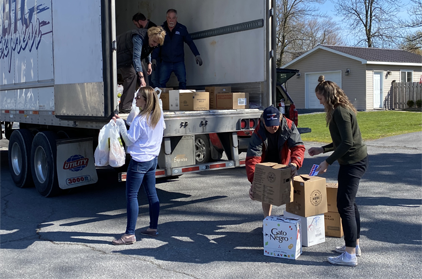
Dianne Kuipers, the Manager of Community Support Services with Carefor led the charge of staff and volunteers stepping up to help ensure food security for many seniors who already access services through Carefor Eastern Counties. “It was all about serving our community and helping to counteract some of the food insecurities that have been prevalent during our pandemic.”
With the help of Edwin Duncan, owner operator of JED Express transport out of South Mountain and his son, Eric Duncan, MP of Stormont, Dundas and South Glengarry, the team loaded up a 53 ft. transport trailer with over 310 food hampers, and travelled from Cornwall to Lancaster, Alexandria, Finch, Ingleside, and Winchester. At each stop, volunteers were waiting to load their vehicles to deliver the food hampers directly to seniors and other eligible recipients within each township. “It was a rewarding day. This is a tough time for a lot of people including our seniors and it’s wonderful Carefor, the team and all the volunteers stepped up to make a difference,” says Eric.
Reflecting on the deliveries made within the counties, Dianne felt “It was a beautiful example of community. It was a beautiful example of neighbours helping neighbours, and that’s what these centres are about, and that’s what this initiative is about.” In a few days of planning the Regional Emergency Response Council’s team was able to procure food, package the food hampers, recruit volunteers, identify people in need of food and ultimately make the final deliveries.
On May 15, the team delivered the remaining 200 food hampers to Carefor clients within the Cornwall area.
With the hopes this initiative would carry-on, Dianne along with the team have since received a number referrals after the deliveries were made. “We expected that in the days to follow we’d be getting more referrals and more inquiries about the food boxes.”
“Nothing happens without a team. Carefor has an amazing team of people.”
Volunteers helping to make the initiative come to life included Carefor Supervisors, Team Leaders, staff and volunteers, the local MP, municipal leaders, and neighbours of the centres. Dianne shared “My heart is full. I can’t tell you how grateful I am for their generosity of time and in their engagement in this initiative. It means more to me and I’m sure more to many folks than we can ever express.”
If you are a senior and need help accessing food during this crisis, please call 2-1-1 to connect with available services including food hampers during the COVID-19 pandemic.
Interested in learning more about the services offered by Carefor Eastern Counties? Click here to learn more.
"*" indicates required fields